My work at the Kimchi Lab
We study how neuromodulators such as acetylcholine and systemic factors such as inflammation influence the function of neural networks critical for attention and awareness. Our translational work is motivated by our desire to understand the pathophysiology of delirium. Our models are rigorously validated using state-of-the-art clinical research scales and neurophysiology. Primary techniques include high-density electrophysiology, imaging of fluorescent reporters of neural activity and neuromodulators, and 3D printing of behavioral devices for longitudinal study.
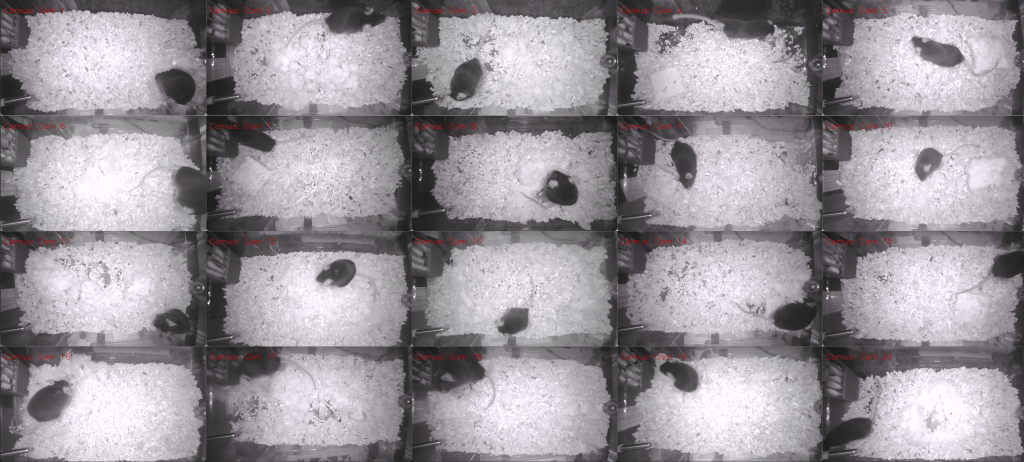
Camus was co-developed at the Kimchi Lab by Tushya Mehta, Nicholas Angulo, Andrew Lu, Silas Staten-Lusty, Riya Palkar , Vincent Im, Eyal Y. Kimchi
at the Department of Neurology, Feinberg School of Medicine, Northwestern University
The manuscript will be published very soon.
Camus: Optimizing Mouse Home Cage Behavior Monitoring using Video
Welcome to the future of behavioral neuroscience. Camus is an open-source, camera-based system designed to transform the way we monitor mice in standard lab settings. Traditional housing setups, with compact cages and opaque lids, have long posed challenges for continuous video monitoring. Camus addresses these limitations by offering a cost-effective solution that enables 24-hour tracking of locomotion, circadian rhythms, feeding, drinking, and nesting behavior.
Integrating commercial off-the-shelf components, such as USB cameras and 3D-printed designs, Camus is built for accessibility and adaptability. With infrared illumination and unobstructive food and water sources, the system ensures minimal disruption to the mice while capturing high-resolution data. It is powered by open-source Python scripts for data collection and analysis and includes a downloadable computer vision model (DeepLabCut) for automated behavior tracking.
Validated for its accuracy and practicality, Camus supports up to 20 cages per desktop computer at just $300 per cage. Experimental results confirmed that mice housed in Camus exhibited natural weights and nesting behaviors comparable to standard setups, along with expected circadian activity patterns. These findings underline the system’s reliability in preserving natural behaviors while providing detailed, automated insights.
Camus is more than a tool; it’s a gateway to deeper exploration of neuropsychiatric diseases. By facilitating continuous home-cage monitoring, this system bridges a critical gap in behavioral research, offering new opportunities to study intricate dynamics over time. All system designs, instructions, and software are available as modifiable, open-source resources, empowering researchers worldwide to adapt and extend Camus for diverse applications.
Explore Camus and join the mission to advance neuroscience through innovation and collaboration. Email kimchilab@gmail.com for more information.
Neuroscience is more than a field of study to me; it is a journey into the unknown, where every discovery opens doors to innovation, healing, and a deeper understanding of what it means to be human
-Tushya Mehta


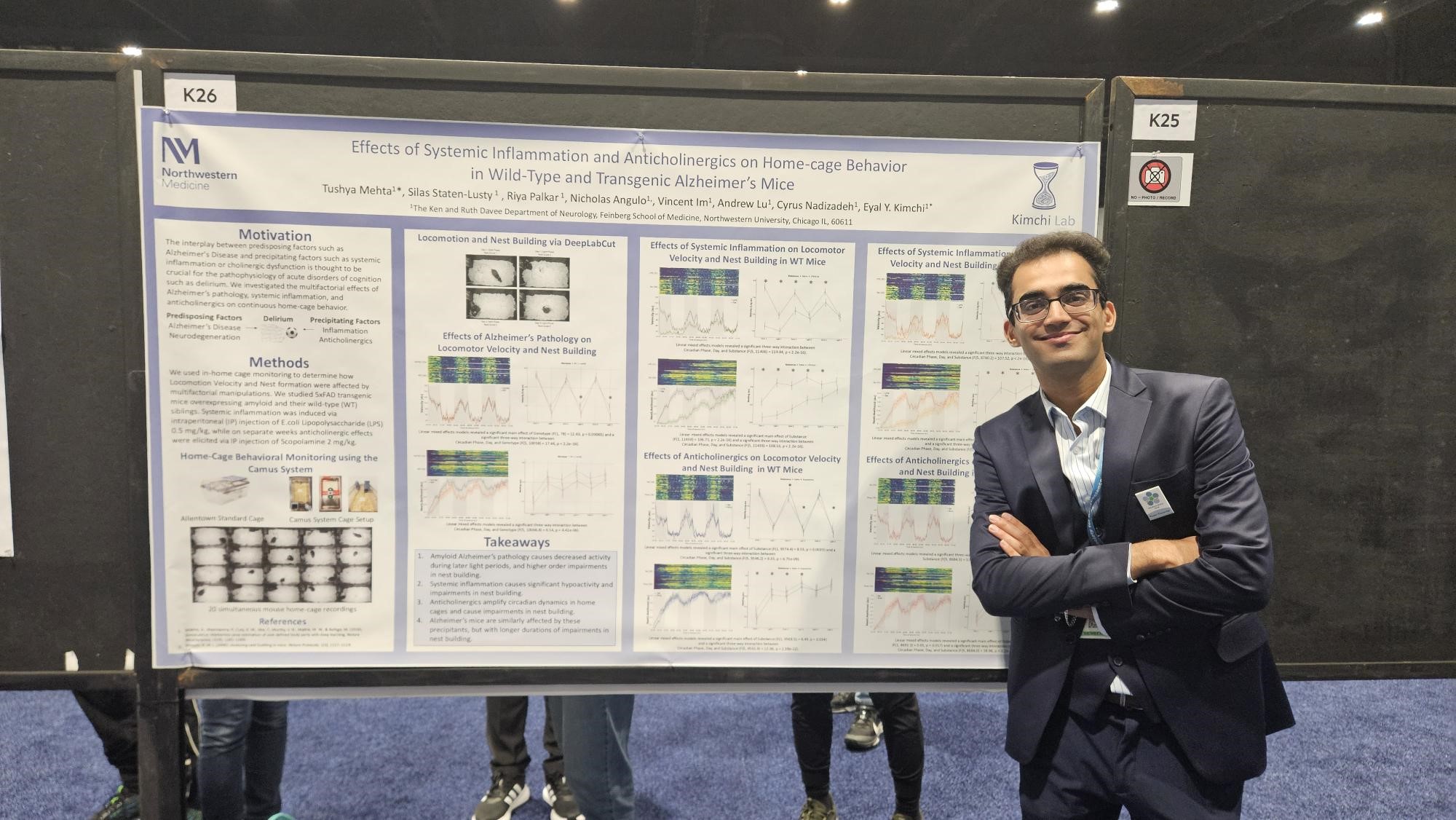
Advancing Understanding of Alzheimer’s and Delirium
My research focuses on uncovering the mechanisms underlying Alzheimer’s disease and delirium through innovative approaches. Using transgenic mouse models, I investigate the progression of Alzheimer’s disease, examining how systemic inflammation and anticholinergic treatments affect behavior and neural networks. Employing advanced tools like EEG, longitudinal behavioral assays, and histological analyses, I explore network-level dysfunctions, including circadian disruptions and EEG slowing. This work aims to bridge experimental findings with computational insights, contributing to a deeper understanding of neurodegenerative diseases and their complexities.
Kimchi Lab – https://kimchilab.org/
 Neuroscience, Art, and Innovation