Collaborative Research: The Role of Narrative in Music Perception

Our study, “The Role of Narrative in Music Perception,” explores when and why we use narratives to understand music, as well as how these music-inspired narratives relate to cultural training. This project builds on a study begun at the University of Arkansas, which revealed 1) that a majority of students listening to orchestral music (without lyrics) imagined a story, or a narrative while listening; and 2) that these storylines often converged or aligned across individuals. Bringing humanistic tools to the analysis of these narratives as well as a cross-cultural framework, the DHLC is broadening the study to explore how these stories converge or diverge across cultures, comparing results from participants at MSU and U. Arkansas to those from participants in rural China, as well as reversing the music chosen so that all participants listen to both Western and Chinese musical samples. This study received funding from the National Science Foundation and has been in progress since May 2016.


Related Readings
Margulis, E.H., Wong, P.C.M., Simchy-Gross, R. et al. What the music said: narrative listening across cultures. Palgrave Commun 5, 146 (2019). https://doi.org/10.1057/s41599-019-0363-1
McAuley JD, Wong PCM, Mamidipaka A, Phillips N, Margulis EH. Do you hear what I hear? Perceived narrative
constitutes a semantic dimension for music. Cognition. 2021;212:104712. doi:10.1016/j.cognition.2021.10471
Modes of Attention: An Interdisciplinary fMRI Study of Reading Jane Austen
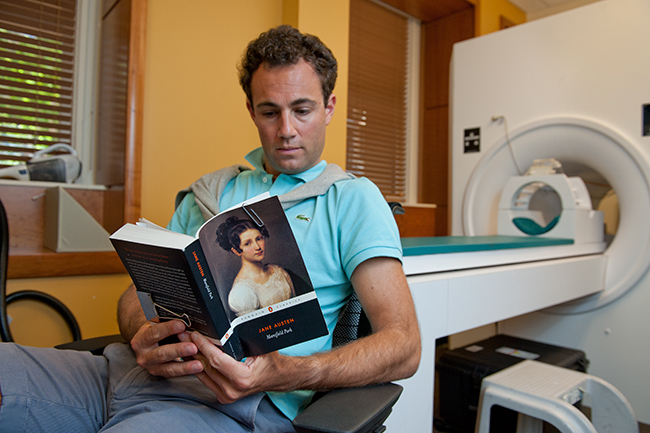


I began to work on this amazing multidisciplinary project under the mentorship of Dr. Natalie Phillips (pictured above) in her lab the Digital Humanities and Literary Cognition Lab.
One of the first forays in the new field of literary neuroscience, our fMRI study of reading Jane Austen—now known in the media as “Your Brain on Jane”—sought to explore not so much the value of reading Austen’s novels but the cognitive complexity of the various modes of attention we can bring to any book. The goal of the study was to investigate the cognitive value and complexity of two forms of literary attention: close reading, or formal literary analysis, and pleasure reading, or becoming “lost in a good book.” Eighteen Ph.D. students at Stanford University were asked to read the first two chapters of Jane Austen’s Mansfield Park––the first chapter on their own and the second chapter inside the scanner where they were instructed to oscillate between pleasure reading (when the text was outlined in green) and literary close reading (when the text was outlined in red). To add nuance to our comparison of these two modes of attention, our study did something that, at the time, was fairly unprecedented. We combined two neuroscientific tools: fMRI and fMRI-compatible eye tracking. Simultaneously, we incorporated humanist methods within conventional post-scan surveys, asking subjects to write literary essays. Because of this choice, our subjects truly brought life and color to the study.
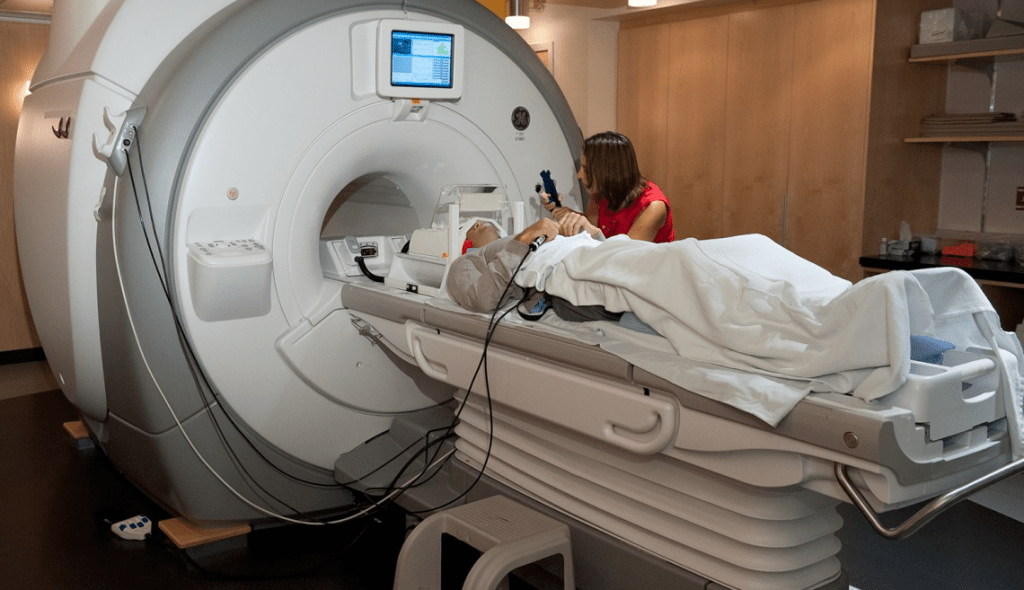
The fMRI machine in use while a lab member watches over.
Four lab members stand in front of their research poster smiling.
While the essays were originally intended to be only a means of ensuring individuals had successfully completed the task (i.e., close reading), it turned out the subjects were quoting the text, managing to maintain a high level of literary sophistication despite not being able to access the narrative at all while writing. Selecting extremely concrete examples from Austen’s highly abstract language in Mansfield Park, they used these moments in the text to support a variety of analyses, anchoring their essays on tangible objects they remembered such as “sashes,” “gold paper,” “artificial flowers,” a “pug,” and a “gooseberry tart.” More information on the results of this study can be found in our various
Related Readings
Intellectual History, and the Importance of Individual Difference,” Jane Austen and the Sciences of Mind, ed. Beth Lau, Routledge 2017.
Phillips, N. & Rachman, S. “Literature, Neuroscience, and Digital Humanities.” (Phillips primary author) Between Humanities and the Digital. Ed. T. Goldberg & P. Svensson. MIT Press, Jan. 2015
 Neuroscience, Art, and Innovation